Sing Before They Speak: How Music Helps With Language Delays
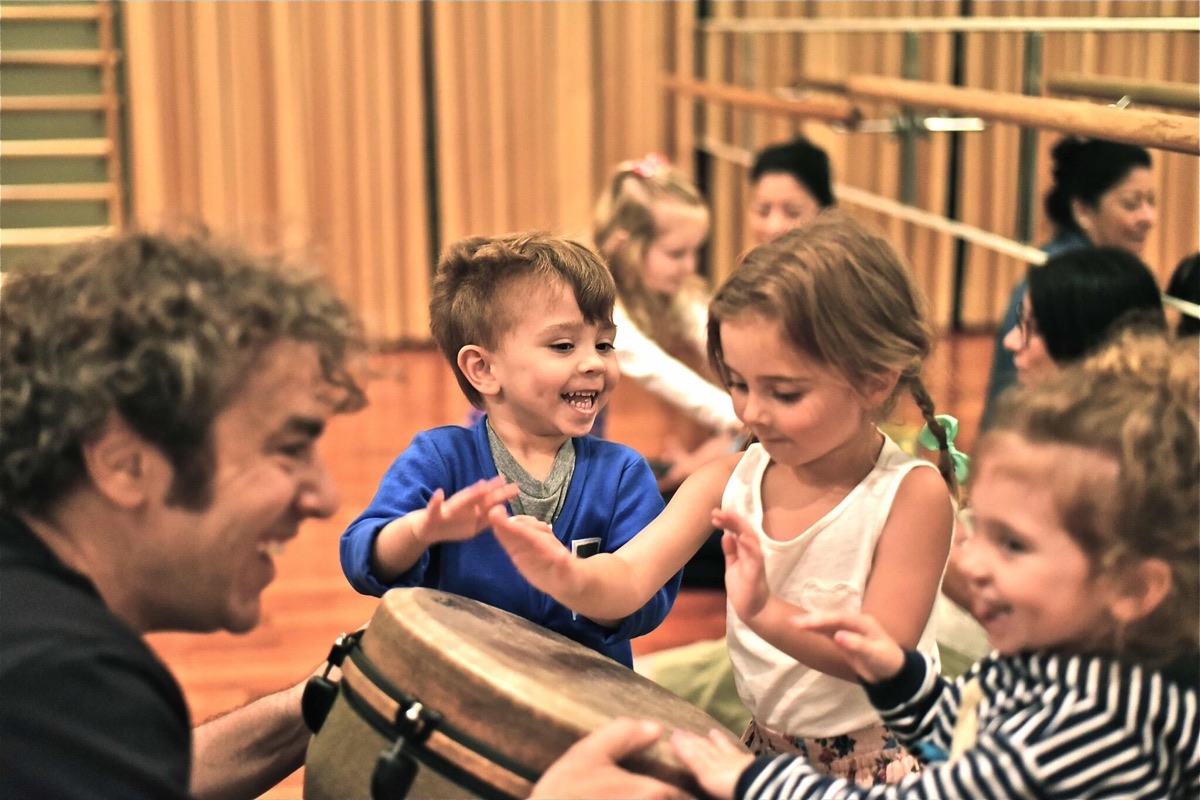
A few years back I had a two-year-old in class who hadn’t said a single word to me. Not “hi,” not his own name, nothing. But the second I picked up the drum and started a steady beat, he was right there next to me, matching every hit. When I paused mid-pattern and waited, he’d fill the silence with a sound of his own. He wasn’t talking. He was absolutely communicating.
His mom pulled me aside after class, half apologizing, half worried. “He’s so behind on words. Does the music even matter if he’s not saying anything?” I already knew the answer. I have studied this, and I have seen it in the classroom more times than I can count. Rhythm was the language he already had. Our job was just to keep meeting him there.
What music can (and can’t) do
Let me be straight with you, because I’ve seen how much a worried grown-up wants a simple fix. Music is not a diagnosis. It cannot tell you whether your child has a speech delay. If your pediatrician or a speech-language pathologist is already in the picture, that stays the main plan. What I offer in class is extra practice: songs, rhythm, and a room full of people who are happy to wait for a sound.
What music can do is give a child a low-pressure place to practice the building blocks under language: listening, waiting for a turn, matching a sound, feeling successful when they “answer” something. Songs slow speech way down and repeat it, which is forgiving in a way regular conversation just isn’t.
Think of music as scaffolding around language, not a substitute for it. Class can be the fun, encouraging side project running alongside whatever support your family already has.
🥁 Tip 1: Let rhythm be the first “word”
A lot of my late-talking kids find their voice through their hands and feet before their mouth. A drum, a shaker, a stomp on the beat. That’s not a consolation prize. That’s a real form of expression, and it usually comes with eye contact and shared attention, which are huge.
At home, you can join a toddler’s banging instead of redirecting it. Clap along, echo their rhythm back, and let them lead for a minute. You’re teaching turn-taking without a single flash card.
🗣️ Tip 2: Use call-and-response, even with sounds instead of words
Call-and-response doesn’t require your child to say anything intelligible. If I sing “ready, set…” and pause, I’ll take a grunt, a squeal, a hand clap. Anything that fills the gap gets celebrated like it’s a full sentence, because functionally, it is.
This is basically what researchers call serve-and-return: a child sends a signal, a grown-up responds warmly, and back-and-forth learning happens. The Harvard Center on the Developing Child’s work on serve-and-return is the clearest explanation I’ve found of why these tiny exchanges build real developmental skills, music or not. It lines up exactly with what I feel happening in the room every week, and it’s a big part of how we build our language and literacy work into every class.
🐢 Tip 3: Slow the song down on purpose
When a child seems to be struggling to keep up verbally, I’ll slow a familiar song way down, almost like a record on the wrong speed. Suddenly syllables that used to fly by become chewable. I’ve watched kids’ mouths start moving for the first time on a song they’ve heard for months, simply because we gave them the extra half-second.
Try it at home with one favorite song a week. Stretch it out, exaggerate the mouth shapes, and don’t rush to the next verse.
🎵 Tip 4: Make their name into a song
Name songs are some of the most reliable tools I have. Singing “Maaa-ya’s here today!” with a clap on each syllable gets attention that a plain “hi Maya” often doesn’t. Kids who don’t yet answer to spoken cues will frequently turn toward a sung one. It’s a small, repeatable win you can use at drop-off, bath time, or the car seat.
If you want a full class built around this kind of gentle, connected repetition, our Grown Up & Me classes are designed exactly for that stage, with a caregiver right in the mix the whole time.
When it’s time to talk to a professional
Here’s where I want to be gentle but honest. If your toddler isn’t using the gestures, sounds, or words your pediatrician would expect for their age, or you just have a nagging feeling something’s off, please ask for a speech-language evaluation. You are not overreacting, and you are not causing a problem by asking.
A delay is not a reflection of anything you did or didn’t do at home. Kids develop language on a real range of timelines, and getting eyes on it early tends to help, never hurts. Music class can absolutely run alongside an evaluation or a speech-language pathologist. In fact, several families in my room split their week between both, and both sides tell me the other one helps.
I still think about that little drummer sometimes. Months later, mid-song, he shouted his own name for the first time, right on the beat. His mom lit up like someone had flipped a switch. Music didn’t “fix” anything on its own. It just gave him a doorway he was ready to walk through, on his own timeline, with people cheering from both sides.
👉 Curious whether a class could be part of your family’s toolkit? Find a Rockness class near you, or read more about what to expect at your baby’s first music class.
See you in the circle,
Mr. Michael 🎸
Rockness Music
Quick answers
Can music class help a toddler who isn’t talking yet?
Music class can give a late-talking toddler low-pressure chances to practice listening, turn-taking, and sound play. It is not a diagnosis, but many kids find songs an easier on-ramp to communication than conversation.
Is a speech delay my fault as a parent?
No. Language develops on a range of timelines for reasons that are rarely about anything a caregiver did or didn’t do. Noticing and asking questions is good parenting, not a red flag.
When should I talk to a professional about a language delay?
If your child isn’t using gestures, sounds, or words in the ranges your pediatrician expects, or you feel a persistent gut sense something is off, ask for a speech-language evaluation. Early support tends to help, and it never hurts to check.