
Rhythm & Motor Skills: Why Banging on Pots Matters
I want to say something that might get me banned from a few kitchens: the pot-banger in your house is doing real work. Not cute work. Not “aw, look at that” work. Actual motor-development, brain-building work, with a wooden spoon as the tool.
I know it doesn’t feel that way at 6:45am when a two-year-old has discovered the stockpot has the best resonance in the house. But stick with me. By the end of this, I want you to feel a little guilty for every time you said “please stop banging.”
Kidding. Mostly. Some boundaries are fair (see below). But the instinct underneath the banging? That instinct is gold.
🥁 What’s actually happening when they bang
A toddler smashing a spoon on a pot lid isn’t just making noise, they’re running a whole developmental drill:
- Bilateral coordination: using both hands, sometimes doing different things with each
- Timing and pattern: bang-bang-pause, bang-bang-pause, without anyone teaching them that
- Cause and effect: “I hit it, it made a sound, I can control that sound”
- Sensory input: the vibration, the volume, the feedback in their hands and ears
- Focus: try pulling a two-year-old off a good drum groove. It takes effort because they are locked in
That’s not a coincidence. Play researchers at organizations like Zero to Three and the Harvard Center on the Developing Child point to exactly this kind of repetitive, self-directed, physical play as a driver of early brain architecture. Repetition isn’t your child being stubborn. Repetition is the lesson.
🍳 Why kitchen drums count as real music
I’ve had parents apologize in class because “all my kid does at home is bang on stuff.” I tell them the same thing every time: your kid already built a drum kit out of Tupperware. That’s not a problem I need to fix. That’s a musician I get to redirect.
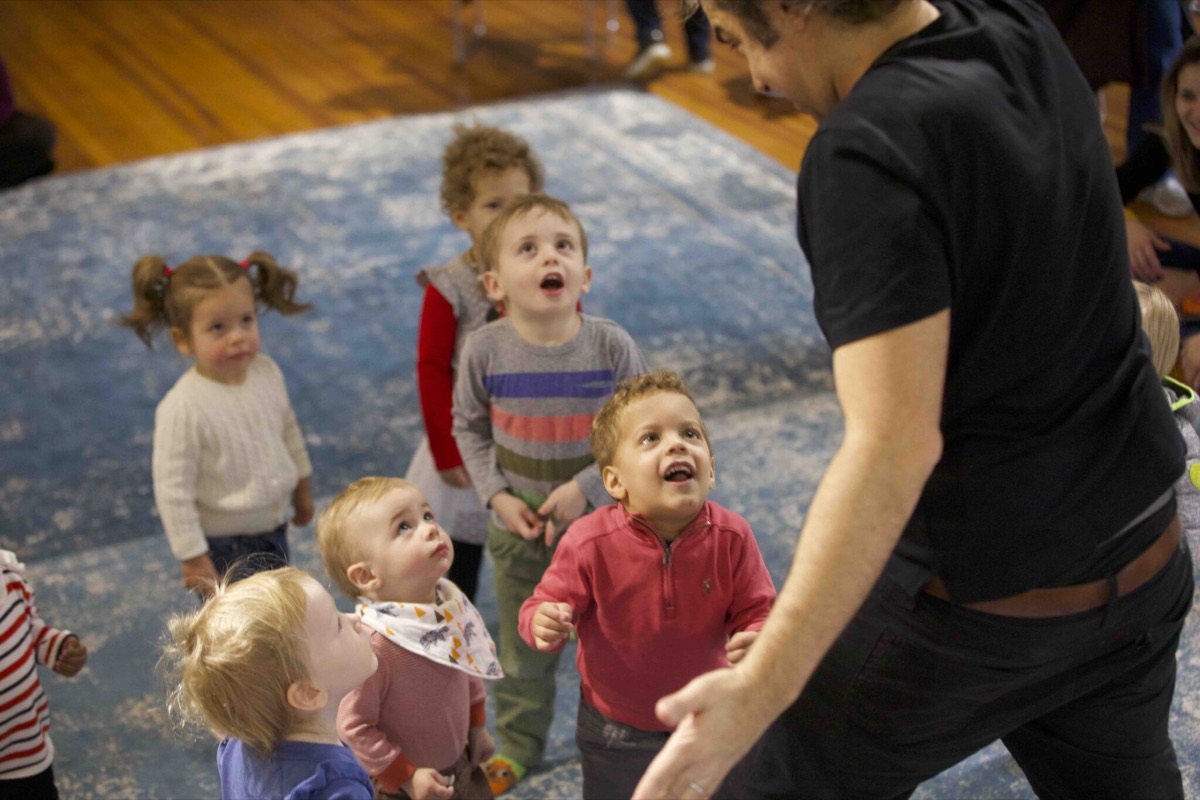
In our Rockness Music classes, drums and shakers exist for the exact same reason the pot cabinet exists at home: kids need something they can hit, shake, or strike and immediately hear the result. It’s the most honest instrument category there is. No fingering, no reading notes, just body plus object plus sound. A three-year-old understands a drum instantly.
If your pot-banger has graduated to wanting real instruments (or you’re tired of losing lids), easy homemade instruments you can build at home is a good next stop.
🙌 The social side nobody mentions
Here’s the part that surprises parents: banging isn’t always a solo act. Watch a toddler drum next to a sibling or a friend and you’ll usually see one of two things happen. Either they start copying each other’s pattern, or they start taking turns, one bangs, the other waits, then swaps.
That’s turn-taking. That’s early social timing. In class, we build on this directly with call-and-response: I play a short rhythm, the group answers it back. It looks like a game. It’s actually a rehearsal for conversation, for listening, for “your turn, my turn.” The NAEYC talks a lot about play as the vehicle for social-emotional growth, and rhythm games are one of the clearest, lowest-stakes ways to practice it.
🏠 Build a “safe kitchen drum kit” (guilt-free version)
You don’t need to eliminate the banging. You need to give it a home. Here’s what’s worked for the families I coach through this:
- Pick 2–3 “drum” pots that aren’t your good cookware, and store them low where your toddler can reach independently
- Swap metal spoons for wooden ones to soften the volume (your ears will thank you)
- Add a mixing bowl and an upside-down bucket for pitch variety, kids notice different pots sound different, and that’s early ear training
- Designate a spot: a corner, a mat, a “stage,” so banging has a place, not everywhere
Bold takeaway: containment, not cancellation. Give the behavior a home and it stops feeling like chaos and starts feeling like a routine you both enjoy.
🛑 Stop/start games (turn noise into focus)
This is the single best trick I give parents in the classroom, and it works with a pot lid just as well as it works with a real drum:
- Let them bang freely for a few seconds
- Call out “STOP!” with a big hand signal, freeze together
- Count to three, then say “GO!” and bang again
Kids find this hilarious, and hidden inside the giggles is impulse control practice: the skill of starting and stopping a body movement on a cue. That’s the same muscle they’ll use for “freeze dance,” for waiting their turn in line, and eventually for sitting through a whole song in circle time.
We run this exact game in our weekly classes, and it’s consistently one of the loudest, happiest five minutes of the room.
🎉 Where pot-banging shows up outside the kitchen
Once a kid has the banging bug, it travels. I’ve watched it show up at a friend’s piano, on a table at a restaurant (sorry, other diners), and enthusiastically at birthday parties the second a real drum appears. If your child’s preschool is weighing whether structured rhythm time belongs in the day, it’s worth pointing them toward enrichment programming built around movement and music, since this is exactly the kind of skill-building play it supports.
✅ The permission slip
So here’s your permission slip, from one parent-adjacent adult to another: the banging is not a phase to survive. It’s a skill to nurture, with a little structure so it doesn’t take over dinner prep. Bilateral coordination, timing, cause-and-effect, focus, even social turn-taking, all of it, from a pot and a spoon.
👉 Want to see where that energy goes next? Find a Rockness Music class near you and watch the kitchen drummer turn into the kid who won’t put down the real thing.
Let them bang. It’s not noise. It’s rehearsal.
Keep the beat going,
Mr. Michael 🎸
Rockness Music
Quick answers
Is pot-banging actually good for my toddler, or is it just noise?
It’s real motor and rhythm practice. Banging on pots builds bilateral coordination, grip strength, timing, and cause-and-effect learning. It’s loud, but it’s not empty play.
How do I make pot-banging less overwhelming at home?
Set up a designated kitchen drum kit in one spot, use wooden spoons for a softer tone, and add stop-and-start games so the play has structure. A little containment goes a long way.
What skills is my child building when they drum on pots?
Two-handed coordination, steady timing, focus, and early turn-taking if you play call-and-response. These are the same foundations we build on with drums and shakers in Rockness Music class.